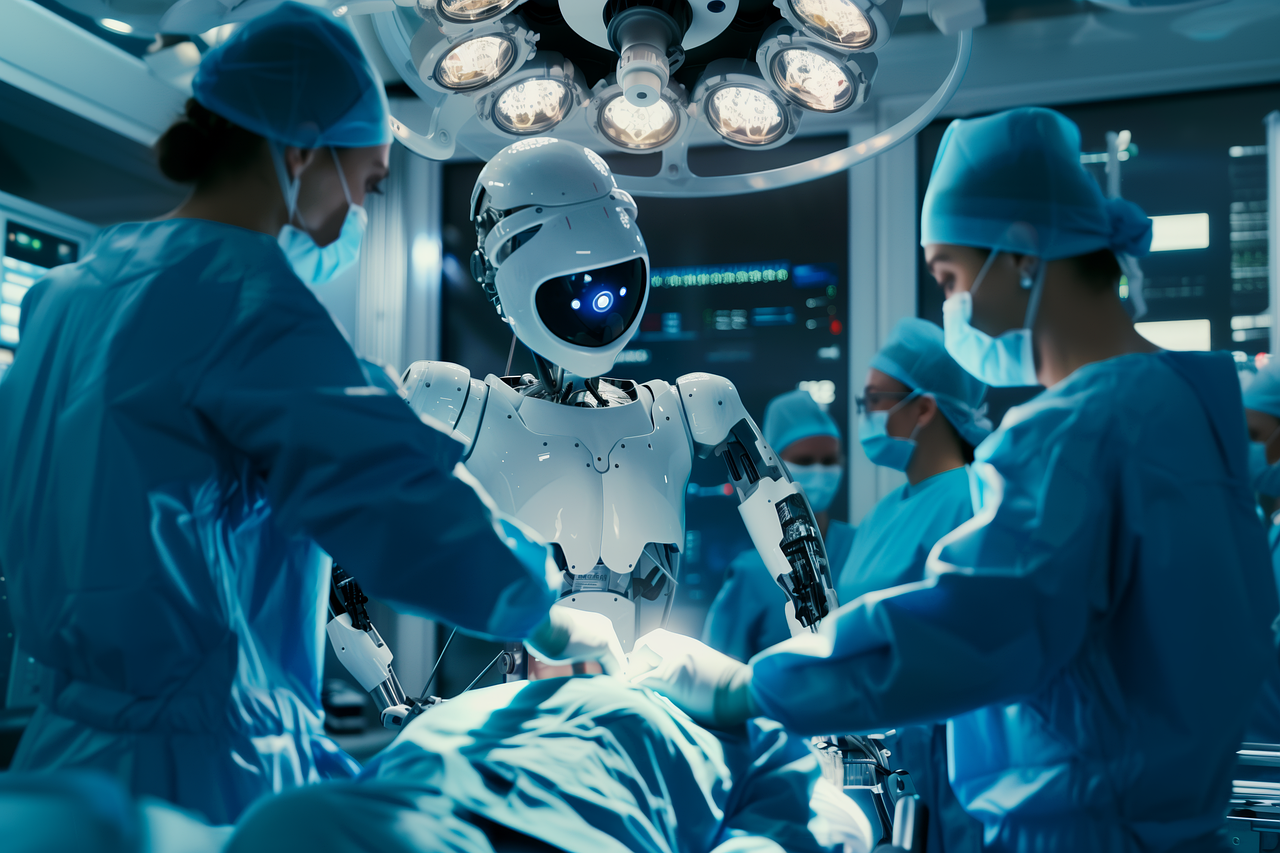
For decades, surgical progress has been driven by human dexterity and judgment.
Today, that mastery is being multiplied by data, sensors, and automation.
The fusion of artificial intelligence, robotics, and real-time analytics is ushering in a new chapter — one where machines amplify human precision rather than replace it.
In this hybrid era, surgeons become system pilots, leveraging robotics for steadiness, algorithms for prediction, and data for insight.
The result: safer operations, standardized quality, and measurable performance improvements.
From Skill to System
Traditional surgery depended almost entirely on individual skill.
Experience dictated consistency; training defined outcomes.
But variation — between surgeons, institutions, or even days — remained inevitable.
Modern robotic platforms have changed that foundation.
They translate human motion into mechanically perfect, tremor-free movements, with millimeter-level accuracy.
High-definition 3D vision, enhanced ergonomics, and AI-assisted stabilization reduce fatigue and magnify the surgeon’s control.
Studies comparing robotic and conventional minimally invasive techniques demonstrate reduced complication rates, shorter hospital stays, and faster recovery times.
Yet the deeper revolution isn’t mechanical — it’s informational.
The Rise of Cognitive Robotics
The new generation of surgical systems are not just tools; they are learning platforms.
Each procedure produces gigabytes of video, force, and motion data — feeding AI models that continuously refine technique.
Machine learning now allows robots to recognize anatomical structures, detect safe zones, and even anticipate surgeon intent.
In some settings, algorithms provide gentle counter-resistance or haptic cues when a movement drifts toward a high-risk area.
Cognitive robotics thus transform the operating room from a manual workspace into an adaptive learning environment.
“The surgeon of tomorrow will not only operate with their hands — but with the collective intelligence of every operation performed before.”
AI as Surgical Co-Pilot
Artificial intelligence in surgery functions best as a co-pilot, not an autopilot.
Its main strengths lie in pattern recognition and predictive analytics:
- Intraoperative guidance: Real-time tissue segmentation and structure recognition from video feed.
- Risk prediction: Algorithms using vitals, labs, and imaging to forecast complications.
- Workflow mapping: Identifying procedural steps and timing for quality benchmarking.
- Outcome optimization: Correlating subtle technique variations with recovery metrics.
Clinical trials in AI-assisted laparoscopic and endoscopic surgeries already show measurable reductions in error frequency and procedure variability.
AI extends the surgeon’s situational awareness — seeing what humans might miss, and analyzing what humans can’t measure fast enough.
Haptics, Vision, and Sensory Feedback
A key challenge in robotic surgery has been the loss of tactile sensation.
When the surgeon is separated from the patient by a console, force feedback becomes abstract.
Recent innovations are closing that gap.
Advanced haptic systems now deliver pressure, tension, and texture feedback through controllers, reintroducing the “feel” of tissue manipulation.
Simultaneously, multispectral and fluorescence imaging reveal vascular and nerve pathways beyond human vision.
This multisensory integration redefines what “seeing” and “feeling” mean in the operating room — transforming intuition into quantifiable feedback.
Training and the Learning Curve
Digitization brings another breakthrough: objective training data.
Surgical simulation and video analytics now measure motion economy, instrument path efficiency, and error frequency.
AI-assisted coaching platforms provide instant feedback during training, accelerating skill acquisition and standardizing technique.
What once took years of apprenticeship can now be monitored, benchmarked, and optimized with data — without compromising safety or ethics.
Ethics, Trust, and Accountability
As surgical systems become more autonomous, questions arise:
Who holds responsibility when an algorithm influences a decision?
How transparent should the AI’s “reasoning” be?
Regulatory bodies are addressing these issues through emerging frameworks for explainable AI and human oversight requirements.
The consensus is clear: autonomy must never replace accountability.
Human judgment remains the ultimate authority in every critical moment.
Global Outlook
AI and robotics are also reshaping access to care.
Remote robotic platforms combined with high-speed connectivity now enable tele-surgery and mentorship across continents.
Hospitals in developing regions can receive real-time guidance from global experts.
While regulatory and infrastructure barriers remain, early pilot programs in Asia, Europe, and the Middle East show the transformative potential of global collaboration — creating a truly connected surgical ecosystem.
The Path Forward
The next era of surgery will not be defined by larger machines but by smarter ecosystems — systems where data, robotics, and human skill operate as one.
By 2035, the standard operating room may feature:
- Predictive guidance integrated directly into surgical displays
- AI systems learning continuously from every procedure
- Real-time analytics linking intraoperative data to outcomes
- Distributed surgical networks enabling expertise without borders
Precision will no longer be limited to the surgeon’s hand — it will exist throughout the system.
When human intuition meets machine intelligence, surgery becomes not only more precise but also more human: safer, more consistent, and globally accessible.